

President Joe Biden will pass up the normal video require his very first in-person conference with a foreign leader on Friday, when Japan’s Prime Minister Yoshihide Suga , who is completely immunized, satisfies Biden at the White House .
A brand-new president’s very first conference slot with a foreign leader is usually scheduled for leading allies. Biden’s predecessor President Donald Trump held his very first party with British Prime Minister Theresa May (although he satisfied previous Japanese Prime Minister Shinzo Abe for a casual 90-minute discussion at Trump Tower in New York prior to his inauguration).
Experts state that Biden’s option to satisfy Suga prior to other world leaders reveals that he sees a few of the most essential problems facing his administration—– consisting of how to handle China—– as being found in the Indo-Pacific area.
” Biden‘‘ s choice to hold his very first in-person top with Suga sends out a strong signal about Japan’s significance as a partner in handling a few of the most significant difficulties dealing with the United States and the value of the Indo-Pacific area in Biden‘‘ s diplomacy,” states Kristi Govella, an assistant teacher of Asian Studies at the University of Hawai‘‘ i at M ā noa.
.
Countering Trump’s “America initially” isolationism, Biden has actually made fixing ties with allies a top priority because his inauguration. On Mar. 12, Biden signed up with a virtual top with the leaders of Australia, Japan and India—– the very first top for the leaders of the so-called ” Quad” tactical bloc. Days later on, Secretary of State Antony Blinken and Secretary of Defense Lloyd Austin took a trip to Japan and South Korea on the Biden administration’s very first Cabinet-level journey abroad, in conferences that have actually been called the 2-plus-2.
” Biden wishes to restore U.S. networks of impact that were shattered by Trump’s unpredictable gambits in diplomacy,” Jeffrey Kingston, the director of Asian Studies at Temple University’s Tokyo school, informs TIME. “He is revealing the U.S. is back in Asia and will highlight multilateralism.”
The U.S. relationship with China does not look set to enhance considerably in the near-term. Relations sank to a decades-low nadir throughout the Trump administration, and top-level conferences in between China and the U.S. in Alaska last month came down into finger-pointing and squabbling. The U.S. excoriated China for its hazards versus Taiwan and its clampdowns in Xinjiang and Hong Kong, while a leading Chinese diplomat lectured the Americans on race problems and other U.S. failings.
Tensions with China have actually offered restored value to Washington’s alliance with Tokyo. Here’s what to get out of the top.
.What’s on the program for Biden and Suga?
Biden, 78, and Suga, 72, are anticipated to cover a variety of subjects consisting of environment modification, COVID-19, financial ties, innovation and security problems. How to work together to deal with China, which the U.S. discovers itself significantly at chances with, is most likely to be an overarching style.
” In regards to the significant value of the conference, I believe whatever is everything about China,” Yoshikazu Kato , a research study fellow at the Rakuten Securities Economic Research Institute in Tokyo, informs TIME.
China’s territorial claims in the East and South China Seas are an increasing point of stress in between the U.S. and China and a significant security issue for Japan . According to the Japanese broadcaster NHK World , Chinese vessels went into Japan’s territorial waters more than 10 times this year around contested islands called the Senkaku in Japan and the Diaoyu in China.
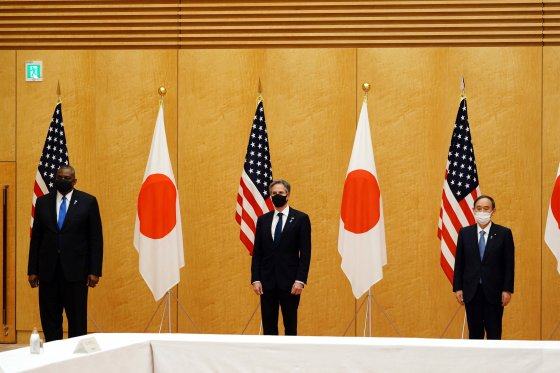 Eugene Hoshiko—– POOL/AFP/Getty Images Japan’s Prime Minister Yoshihide Suga (R) postures with U.S. Secretary of State Antony Blinken (C) and U.S. Defense Secretary Lloyd Austin (L) throughout a courtesy call at the prime minister’s main home in Tokyo on March 16, 2021.
Taiwan is most likely to be a primary significant subject of conversation. Stress over the island, which China thinks about a breakaway province, have actually increased as China increases military activity in the location.
Biden might likewise look for to attend to a “growing aggravation over distinctions in worths diplomacy and Tokyo’s ambivalent dedication to human rights and democracy,” states Kingston. “Japan supports human rights and democracy however is not prepared to run the risk of anything in assistance of those worths.”
The U.S. and a number of other nations have actually slapped Chinese authorities with sanctions over deteriorating political liberties in Hong Kong and the treatment of the Uighur ethnic minority in China’s northwest Xinjiang area, however Japan has actually not done the same. China’s Foreign Minister cautioned Japan throughout a call on Apr. 5 versus enforcing punitive steps—– and Japan is not surprisingly mindful about annoying its biggest trading partner .
Read More: Yoshihide Suga Is Japan’s New Prime Minister. Here’s What That Means for the U.S.
.What does the Biden conference indicate for Suga and Japan?
A senior Japanese diplomat informed TIME that the conference is a possibility for the nations to “show to the world that the open and complimentary system works and democracy and guideline of law count.”
The top might likewise offer a possibility for Suga, who was mainly untried in foreign affairs prior to entering the function of Prime Minister, to reveal his guts. He might hope that the conference will enhance his appeal in the house, where he acquired a domestic program overloaded by the coronavirus pandemic, the nation’’ s greatest ever financial downturn and the delayed Tokyo Olympics– set to proceed in July in spite of opposition from a bulk of the Japanese public. His approval score has toppled over public discontentment with his federal government’s reaction to the COVID-19 pandemic, to name a few problems.
. 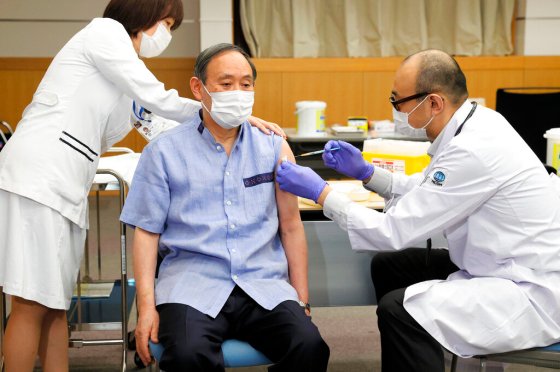 Kyodo News/AP ImagesJapanese Prime Minister Yoshihide Suga gets his very first dosage of Pfizer’s COVID-19 vaccine at National Center for Global Health and Medicine in Tokyo on March 16, 2021.
The see uses Suga” a valuable chance to increase his qualifications as a skilled steward of the U.S.-Japan alliance, ata time when domestic political assistance for his administration has actually decreased, “states Mireya Solís, the director of the Center for East Asia Policy Studies at the Washington D.C.-headquartered think-tank the Brookings Institution.
.
Not all professionals concur that the go to will settle. With a lot of issues in the house,” this is bad timing for Suga to go to the U.S.” states Kato.” Suga’ssee to the U.S. will not be that popular locally, it will not add to enhancing his extremely low appeal. “
.
Read More: Yoshihide Suga Will Succeed Shinzo Abe as Prime Minister. What’s Next for Japan?
. What will be the result of the Biden and Suga top?
A joint declaration is anticipated to be released following the conference, and the communique released after last month’s 2-plus-2 conferences might offer some ideas about what will be consisted of. That declaration” highlighted the significance of peace and stability in the Taiwan Strait,” raised issues about human rights in Xinjiang and Hong Kong and stated America’s” steadfast dedication” to come to Japan’s defense if requirement be.
. If the declaration revealed assistance for Taiwan, #ppppp> Pundits state that it would be considerable. It has actually been years considering that U.S. and Japanese leaders resolved the value of Taiwan’s security in a joint missive.
.
But professionals state that Japan’s financial reliance on China suggests that it can just press Beijing up until now. Solís, of the Brookings Institution, states that Suga will” most likely look for a strong message of deterrence towards China on the maritime domain however will tread thoroughly on delicate problems– Taiwan, sanctions on human rights infractions– to prevent a sharp degeneration of relations with Beijing.”
.
Suga is likewise anticipated to welcome—Biden to this summer season’s Olympics in Tokyo , according to the Japanese media.
.
Whatever the result, the conference marks a significant shift in U.S. diplomacy from that of the Trump administration.” American allies in Asia will invite increased engagement and predictability under the Biden administration,” states Govella, “though there is sticking around issue about thedesire and capability of the U.S. to play a strong management function, provided its turbulent domestic scenario. “
.
Read more: time.com


